Al-Fayoum Oasis
Al-Fayoum Oasis is the central desert sanctuary in Paulo Coelho's The Alchemist, a place where the novel's themes of love, destiny, and the Language of the World converge. Located in Egypt, it is the destination of the caravan Santiago joins after leaving the crystal shop in Tangier. More than a geographical landmark, the oasis functions as a liminal space between the perils of the desert and the final goal of the Pyramids, a neutral ground where the rules of war are suspended and where Santiago's personal legend is tested in ways he never anticipated.
Geography and Neutrality
Al-Fayoum is described as a vast settlement, far larger than many towns in Spain, with three hundred wells and fifty thousand date palms spread among innumerable colored tents. Its size and prosperity make it a crucial stop for caravans crossing the Sahara. The oasis is governed by a sacred tradition of neutrality: because the majority of its inhabitants are women and children, it is considered a refuge where no armies or troops may be stationed. This law of hospitality is strictly enforced; upon arrival, all travelers, including the caravan's own sentinels, must surrender their arms to the tribal chieftains. The leader of the caravan explains that this is a rule of war, and the oasis is a place where the conflict between tribes does not intrude. This neutrality, however, is tested when Santiago's vision of an impending attack forces the chieftains to break their own tradition.
Santiago's Arrival and the Meeting with Fatima
Santiago arrives at Al-Fayoum after a long and arduous crossing of the desert, during which he learns from the camel driver about living in the present and from the Englishman about the Soul of the World. The oasis appears to him as a miracle, a vision of green and water after weeks of yellow sand and blue sky. It is here, at one of the wells, that Santiago meets Fatima, a woman of the desert whose dark eyes and silent smile teach him the most important part of the universal language: love. Their encounter is described as a moment when time stands still and the Soul of the World surges within him. Fatima becomes a treasure greater than any gold, and the oasis becomes the place where Santiago must confront the choice between staying with her and continuing his quest for the Pyramids. Fatima, understanding the ways of the desert, urges him to pursue his destiny, telling him that if she is truly a part of his dream, he will return.
The Vision of the Hawks and the Battle
While meditating on the meaning of love without possession, Santiago observes two hawks flying overhead. He suddenly receives a vision of an armed army riding into the oasis, a clear omen of danger. He reports this to the camel driver, who advises him to speak to the tribal chieftains. Despite initial skepticism, the chieftains, led by an elder who recalls the story of Joseph in Egypt, decide to believe the boy's message. They break the oasis's tradition of neutrality by arming their men. The next day, five hundred tribesmen attack the empty central tent and are ambushed by the oasis's defenders; all but the commander are killed. The commander is hanged from a dead palm tree as punishment for violating the sacred law. For his role in saving the oasis, Santiago is rewarded with fifty pieces of gold and offered the position of counselor, but his destiny lies elsewhere.
The Alchemist and the Departure
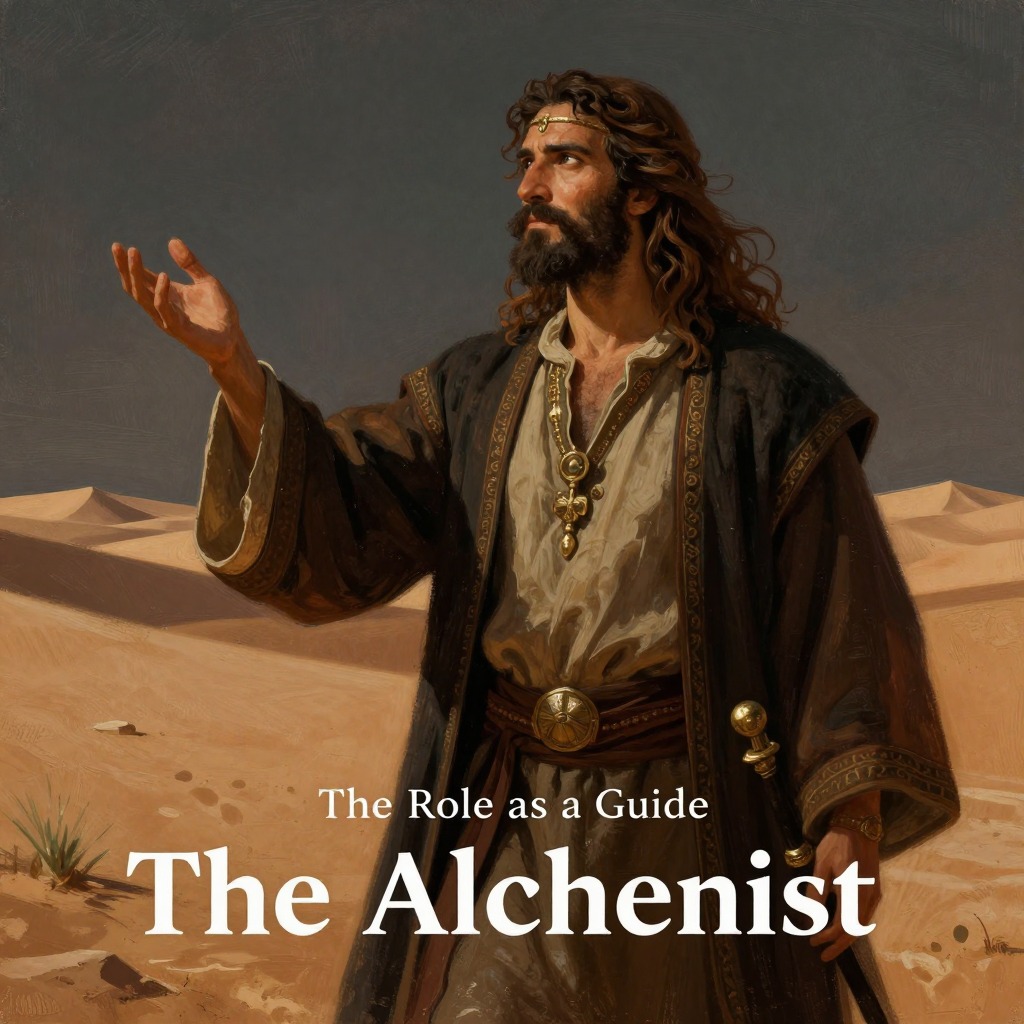
That same night, Santiago encounters the alchemist, a mysterious horseman dressed in black with a falcon on his shoulder, who tests his courage by holding a sword to his forehead. The alchemist reveals that he has been waiting for Santiago, guided by the omens. He tells Santiago that he already knows everything he needs to know and that he must continue toward his treasure. The alchemist warns him that love never keeps a man from his destiny; if he abandons his quest, it is because it was not true love. After a sleepless night, Santiago bids farewell to Fatima at her tent, promising to return. He then leaves the oasis with the alchemist, riding into the desert toward the Pyramids. The oasis, once a place of refuge and love, becomes a memory that Santiago carries with him, a symbol of what he is fighting for and what he must temporarily leave behind.
Thematic Significance
Al-Fayoum Oasis is the narrative's emotional and spiritual heart. It is where Santiago learns that love is not an obstacle to destiny but a part of it, and where he proves his ability to read the omens of the desert. The oasis also embodies the tension between the settled life and the nomadic quest, a theme that runs throughout the novel. The crystal merchant's fear of realizing his dream of Mecca is mirrored in the oasis's static neutrality, yet it is precisely this place of stability that propels Santiago toward his final transformation. The oasis is not the end of the journey but the crucible in which Santiago's resolve is forged, preparing him for the trials that lie ahead and the ultimate discovery that the treasure was always waiting for him back in Spain.